Algorithms in the Criminal Justice System
Summary
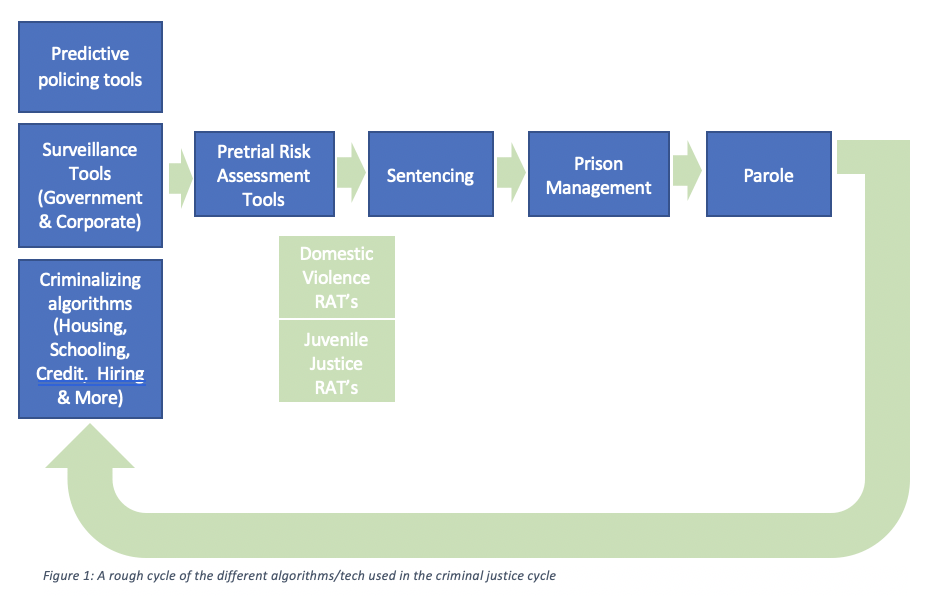
Criminal justice algorithms—sometimes called “risk assessments” or “evidenced-based methods”—are controversial tools that purport to predict future behavior by defendants and incarcerated persons. These proprietary techniques are used to set bail, determine sentences, and even contribute to determinations about guilt or innocence. Yet the inner workings of these tools are largely hidden from public view.
Many “risk assessment” algorithms take into account personal characteristics like age, sex, geography, family background, and employment status. As a result, two people accused of the same crime may receive sharply different bail or sentencing outcomes based on inputs that are beyond their control—but have no way of assessing or challenging the results.
As criminal justice algorithms have come into greater use at the federal and state levels, they have also come under greater scrutiny. Many criminal justice experts have denounced “risk assessment” tools as opaque, unreliable, and unconstitutional. The Supreme Court is also considering whether to take a case on the use of a secretive technique to predict possible recidivism.
Background
"Risk assessment" tools are algorithms that use socioeconomic status, family background, neighborhood crime, employment status, and other factors to reach a supposed prediction of an individual's criminal risk, either on a scale from “low” to “high” or with specific percentages. See Wisconsin’s COMPAS risk assessment questionnaire, from ProPublica. In 2014, then-U.S. Attorney General Eric Holder called for the U.S. Sentencing Commission to study the use of algorithms in courts, concerned that the scores may be a source of bias. At the same time, the Justice Department expressed concern about the use of factors such as education levels, employment history, family circumstances, and demographic information. While the Sentencing Commission has studied the recidivism risk for federal offenders, it has not commissioned a study of risk scores.
Criminal justice algorithms are used across the country, but the specific tools differ by state or even county. In addition, because such algorithms are proprietary, they are not subject to state or federal open government laws. Jurisdictions have generally used one of three main systems, or adapted their own version of each: Correctional Offender Management Profiling for Alternative Sanctions (COMPAS), Public Safety Assessment (PSA) and Level of Service Inventory Revised (LSI-R). COMPAS, created by the for-profit company Northpointe, assesses variables under five main areas: criminal involvement, relationships/lifestyles, personality/attitudes, family, and social exclusion. The LSI-R, developed by Canadian company Multi-Health Systems, also pulls information from a wide set of factors, ranging from criminal history to personality patterns. Using a narrower set of parameters, the Public Safety Assessment, developed by the Laura and John Arnold Foundation, only considers variables that relate to a defendant’s age and criminal history.
A 2016 investigation by ProPublica tested the COMPAS system adopted by the state of Florida using the same benchmark as COMPAS: a likelihood of re-offending in two years. ProPublica found that the formula was particularly likely to flag black defendants as future criminals, labeling them as such at almost twice the rate as white defendants. In addition, white defendants were labeled as low risk more often than black defendants. But the investigators also found that the scores were unreliable in forecasting violent crime: only 20 percent of the people predicted to commit violent crimes actually went on to do so. When considering a full range of crimes, including misdemeanors, the correlation was found to be higher but not exceedingly accurate. Sixty-one percent of the candidates deemed liked to reoffend were arrested for any subsequent crimes within two years. According to ProPublica, some miscalculations of risk stemmed from inaccurate inputs (for example, failing to include one’s prison record from another state), while other results were attributed to the way factors are weighed (for example, someone who has molested a child may be categorized as low risk because he has a job, while someone who was convicted of public intoxication would be considered high risk because he is homeless).
Prediction Fails Differently for Black Defendants
| WHITE | AFRICAN-AMERICAN | |
|---|---|---|
| Labeled Higher Risk, But Didn't Re-Offend | 23.5% | 44.9% |
| Labeled Lower Risk, Yet Didn't Re-Offend | 47.7% | 28.0% |
Source: ProPublica
COMPAS is one of the most widely used algorithms in the country. Northpointe published a validation study of the system in 2009, but it did not include an assessment of predictive accuracy by ethnicity. It referenced a study that had evaluated COMPAS’ accuracy by ethnicity, which reported weaker accuracy for African-American men, but claimed the small sample size rendered it unreliable. Northpointe has not shared how its calculations are made but has stated that the basis of its future crime formula includes factors such as education levels and whether a defendant has a job. Many jurisdictions have adopted COMPAS, and other "risk assessment" methods generally, without first testing their validity.
Defense advocates are calling for more transparent methods because they are unable to to challenge the validity of the results at sentencing hearings. Professor Danielle Citron argues that because the public has no opportunity to identify problems with troubled systems, it cannot present those complaints to government officials. In turn, government actors are unable to influence policy.
Unanswered Questions
Some argue that "risk assessment" should be limited to probation hearings or pre-trial release and not used in sentencing at all. In fact, the COMPAS system specifically was created, not for use in sentencing, but rather to aid probation officers in determining which defendants would succeed in specific treatment types. Others caution against overreliance in sentencing, which may be a natural tendency when given data that appears to be based on concrete, reliable calculations. At least one judge has set aside an agreed upon plea deal and given a defendant more jail time because of the defendant’s high "risk assessment" score. Judge Babler in Wisconsin overturned the plea deal that had been agreed on by the prosecution and defense (one year in county jail with follow-up supervision) and imposed two years in state prison and three years of supervision after he saw that the defendant had high risk for future violent crime and a medium risk for general recidivism.
Professor Sonja Starr argues that "risk assessment" results represent who has the the highest risk of recidivism, but the question most relevant to judges is whose risk of recidivism will be reduced the most by incarceration. Therefore, the consideration of risk in the abstract in sentencing may not advance the goal of deterrence. In addition, the recidivism rate produces a risk score within a particular period (ex: 2 years) from the time of release or from the sentence of probation. It does not convey information about the amount of crime one may commit if given one length of incarceration over another (ex: 2 years rather than 5 years). Starr rejects the assumption that incarcerating those who are considered riskiest will prevent more crimes as an oversimplification, because this view does not consider the effect of crimes undertaken by other individuals, nor that incarceration may make someone who is already risky even more dangerous by increasing their risk of recidivism.
Factors such as demographic, socioeconomic background and family characteristics may serve as a proxy for race. Because these variables are highly correlated with race, they will likely have a racially disparate impact. In addition, because of de facto segregation and the higher crime rate in urban neighborhoods, including neighborhood crime rates will further compound the inequality. As a public policy matter, Starr argues that "risk assessment" factors based on demographic, socioeconomic background and family characteristics may not serve its intended goal of reducing incarceration because mass incarceration already has a racially disparate impact, which means that "risk assessment" algorithms produce higher risk estimates, all other things equal, for subgroups whose members are already disproportionately incarcerated.
Another arguable flaw with the input questions is that the consideration of employment history and financial resources result in extra, unequal punishment of the poor which may violate the equal protection clause, based on the precedent case Bearden v. Georgia in which the Supreme Court rejected Georgia’s argument that poverty was a recidivism factor that justified additional incapacitation. To prevent perpetuating a racially disparate impact, advocates are arguing for a narrow range of questions, such as strictly based on past or present criminal behavior, or an individual assessment of a defendant’s conduct, mental states, and attitudes.
Since the specific formula to determine "risk assessment" is proprietary, defendants are unable to challenge the validity of the results. This may violate a defendant’s right to due process. The use of COMPAS in sentencing has been challenged in Loomis v. Wisconsin as a violation of the defendant’s right to due process on two grounds. The first part of the challenge is that the proprietary nature of COMPAS prevents defendants from challenging the COMPAS assessment’s scientific validity. The state does not dispute that the process is secret and non-transparent, but contends that Loomis fails to show that a COMPAS assessment contains or produces inaccurate information. Second, Loomis argues that the algorithmic is unconstitutional because of the way it considers gender. COMPAS has a separate scale for women and men, so all other factors being equal, assessment results will differ based on gender alone.
'Risk Assessment' Information (state-by-state)
The following table is based on a survey of state practices by EPIC.
| STATE | USE/TYPE (if known) | Has the state conducted a validity study? |
|---|---|---|
| Alabama | Yes. Ala. Stat. § 12-25-33(6) | unknown |
| Alaska | Does not use, but it has been recommended | Unknown |
| Arizona | Public Safety Assessment - for determining pretrial release | unknown |
| Arkansas | Likely state-specific (Parole Risk Assessment Tool) | unknown |
| California (Sample risk assessment documents from San Francisco, and Napa County) | California Static Risk Assessment Instrument (CSRA) - adapted from Washington’s LSI-R | Yes |
| Colorado (sample risk assessment documents) | LSI-R - required in pre-sentencing report | Yes |
| Connecticut | Salient Factor Score - used by parole board | Yes |
| Delaware | LSI-R | Unknown |
| Florida | COMPAS | Yes (for Broward County) |
| Georgia | State-based practice part of the Georgia Prisoner Reentry Initiative | unknown |
| Hawaii | LSI-R | Unknown |
| Idaho | SB 1357 incorporates "risk assessments" at sentencing that authorize alternatives to incarceration for low risk defendants | Unknown |
| Illinois | Selected the Service Planning Instrument developed by Orbis Partners to be used across the criminal justice system; currently LSI-R is being used in the probation system | n/a |
| Indiana (sample risk assessment documents) | Indiana Risk Assessment System at sentencing | Yes |
| Iowa | LSI-R recommended for sentencing | unknown |
| Kansas | Used in parole hearings | unknown |
| Kentucky | Sentencing (Ky. Rev. Stat. Ann. § 532.007(3)) | unknown |
| Louisiana | LARNA (for inmates) - recommended to expand to parole board | unknown |
| Maine | Yes, for sex offenders - recommended for sentencing | unknown |
| Maryland | Recommended for use in sentencing, engaging in a feasibility study | none |
| Massachusetts | For sex offenders | unknown |
| Michigan | COMPAS | unknown |
| Minnesota | for sex offenders, recommended for use at sentencing | unknown |
| Mississippi | used in sentencing | unknown |
| Missouri | uses state-specific instrument | |
| Montana | Parole board uses the Montana Offender Reentry and Risk Assessment tool | unknown |
| Nebraska (sample assessments) | LS/CMI at sentencing | yes |
| Nevada | used by parole board | unknown |
| New Hampshire | New Hampshire SB500 (mandating the use of risk/needs assessments to inform decisions about the length of active supervision for all offenders on probation and parole) | n/a |
| New Jersey | used by parole board | unknown |
| New Mexico | Uses COMPAS prior to arraignment | unknown |
| New York | required by parole board | unknown |
| North Carolina | State-specific tool used for probation and for prisoners | unknown |
| Ohio | Uses Ohio Risk Assessment System, OHIO REV. CODE ANN. § 5120.114 (mandating the adoption of a new unified "risk assessment" tool for use in sentencing as well as for parole and other corrections purposes) | yes |
| Oklahama | Oklahoma Criminal Procedure Statute § 22-988.17 requires the use of LSI-R for anyone eligible for alternative sentencing | yes |
| Oregon (sample assessments) | Public Safety Checklist for Oregon | yes |
| Pennsylvania | 42 PA. CONS. STAT. § 2154.7 (ordering the sentencing commission to develop a "risk assessment" tool for sentencing use) | yes |
| Rhode Island | recommended for probation | n/a |
| South Carolina | used in probation and parole supervision, and in parole release decisions | unknown |
| South Dakota | used in parole hearings and prisons | unknown |
| Tennessee | used in sentencing | unknown |
| Texas (sample assessments) | Texas Risk Assessment System | unknown |
| Utah | LS/RNR (Risk, Need and Responsively Assessment) | validation study for pretrial release risk |
| Vermont | SB 295 authorizes the use of "risk assessments" and clinical screenings at every stage of the criminal justice system | unknown |
| Virginia | ||
| Washington | Uses LSI-R, WASH. REV. CODE § 9.94A.500 (requiring the court to consider "risk assessment" reports if they’ve been done) | unknown |
| West Virginia | Probation officers must conduct "risk assessment" tests; prior to discharging certain sex offenders, a "risk assessment" test must be performed to determine their risk of risk offending; "risk assessment" not used in sentencing (2013 governor’s report), | for LSI/CMI |
| Wisconsin (sample assessment documents) | COMPAS | See "EPIC FOIA Documents" below |
| Wyoming | COMPAS for prisoners | unknown |
EPIC's Interest
EPIC has a strong interest in open government. Public disclosure of this information improves government oversight and accountability. It also helps ensure that the public is fully informed about the activities of government. EPIC routinely files lawsuits to force disclose of agency records that impact critical privacy interests.
EPIC also has a strong interest in algorithmic transparency. Secrecy of the algorithms used to determine guilt or innocence undermines faith in the criminal justice system. In support of algorithmic transparency, EPIC submitted FOIA requests to six states to obtain the source code of "TrueAllele," a software product used in DNA forensic analysis. According to news reports, law enforcement officials use TrueAllele test results to establish guilt, but individuals accused of crimes are denied access to the source code that produces the results.
EPIC FOI Documents
EPIC obtained the following documents concerning criminal justice algorithms through state freedom of information requests.
- Missouri
- Missouri Sentencing Advisory Commission (MOSAC) Risk Score: Validation Study (published in 2009 MOSAC Biennial Report)
- Missouri Board of Probation and Parole Risk Assessment (validation studies, policies and procedures)
- Wisconsin
- FY 2010 Northpointe Contract
- FY 2010 Northpointe Contract Addendum
- FY 2013 Northpointe Contract Addendum
- FY 2014 Northpointe Contract
- FY 2014 Northpointe Services Agreement
- FY 2015 Northpoint Contract
- FY 2016 Northpointe Contract
- 2007 COMPAS Validation Study: First Annual Report
- 2009 Evaluating the Predictive Validity of the COMPAS Risk and Needs Assessment System
- 2010 COMPAS Scales and Risk Models Validity and Reliability
- 2012 New York State COMPAS-Probation Risk and Need Assessment Study
- 2013 Predictive Validity of the COMPAS Reentry Risk Scales
- 2013 Summary Statistics Reentry Sample and COMPAS Norm Groups
- 2014 Automated COMPAS PSI Training Resource
- 2014 COMPAS Core Norms for Adult Institutions
- 2014 COMPAS Core Norms for Community Corrections
- 2014 COMPAS Reentry Norms for Women and Men
- 2015 COMPAS Practitioner's Guide
- 2015 Department of Corrections Memo re: COMPAS Use with PSI
- 2016 COMPAS Norming
- COMPAS Fact Sheet
- Comparison of CORE Norm Groups
- COMPAS Decile Cut Points Norming
- 2016 Department of Corrections Emails re: ProPublica Info Request
- 2016 Department of Corrections Emails re: NY Times Interview Request
- Evaluating the COMPAS Risk/Needs Assessment Tool
- Additional Resources on the Application of Risk/Needs Assessment at Sentencing
Resources
Legislation and Regulations
- Sentencing Reform and Corrections Act of 2015 (a landmark sentencing reform bill which would have mandated the use of such assessments in federal prisons)
- Modal Penal Code: Sentencing § 6B.09 (recommending the implementation of recidivism based actuarial instruments in sentencing guidelines)
Government Studies
- Nathan James, Risk and Needs Assessment in the Criminal Justice System, Congressional Research Service (Oct. 15, 2015)
Notable Cases
- United States v. Booker, 125 S. Ct. 738 (2005)
- Mistretta v. United States, 109 S. Ct. 647 (1989)
- State v. Loomis, No. 16-6387 (U.S.) (Wisconsin case in which defendant has petitioned U.S. Supreme Court for certiorari)
- Defendant's Brief (Dec. 4, 2015)
- State's Brief (Jan. 19, 2016)
- Defendant's Reply Brief (Feb. 4, 2016)
- Memorandum Opinion (July 13, 2016)
- Petition for Writ of Certiorari (Oct. 5, 2016)
- Brief of Respondent Wisconsin (Jan. 27, 2017)
- Doe v. Sex Offender Registry Board, 466 Mass. 594, 999 N.E.2d 478 (2013) (holding that the Sex Offender Registry board arbitrarily ignored scientific evidence that female offenders generally pose a much lower risk of re-offense; SORB was empowered to consider any useful information including scientific evidence introduced by offender in arriving at a classification decision, and authoritative evidence was introduced suggesting that establish "risk assessment" guidelines, developed from studies of male offenders, could not predict accurately the recidivism risk of a female offender, and that such risk could not be evaluated without examining the effect of gender)
- Malenchik v. State, No. 79A02-0902-CR-133 (Ind. Ct. App. June 5, 2009) (holding that it was not improper for the trial court to take into consideration a defendant’s LSI-R score at sentencing)
- In re CDK, 64 S.W.3d 679 (Tex. App. 2002) (holding that admitting an assessment report on a father’s sexual deviancy as expert witness testimony was an abuse of discretion because the plaintiff did not provide how the formulas were derived and whether they have ever been subjected to analysis or testing.
Academic Articles
- Melissa Hamilton, Risk-Needs Assessment: Constitutional and Ethical Challenges, Am. Crim. L. Rev. __ (forthcoming 2016)
- Solon Barocas & Andrew D. Selbst, Big Data’s Disparate Impact, 104 Calif. Law Review 671 (2016)
- Nicholas Scurich & John Monahan, Evidence-Based Sentencing: Public Openness and Opposition to Using Gender, Age, and Race as Risk Factors for Recidivism, 40 Law & Human Behavior 36 (2016)
- Jennifer Skeem & Christopher Lowenkamp, Risk, Race, and Recidivism: Predictive Bias and Disparate Impact (March 7, 2016)
- Gregory Cui, Evidence-Based Sentencing and the Taint of Dangerousness, 125 Yale Law Journal Forum 315 (2016)
- John Monahan and Jennifer L. Skeem, Risk Assessment in Criminal Sentencing, Annual Rev. of Clinical Psychology (forthcoming) (Sept. 17, 2015).
- Claire Botnick, Evidence-Based Practice and Sentencing in State Courts: A Critique of the Missouri System, 49 Washington University Journal of Law & Policy 159, 160 (2015)
- Dawinder S. Sidhu, Moneyball Sentencing, 56 Boston College Law Review 671 (2015)
- Jennifer E. Laurin, Gideon by the Numbers: The Emergence of Evidence-Based Practice in Indigent Defense, 12 Ohio State Journal of Criminal Law 325 (2015)
- Melissa Hamilton, Adventures in Risk: Predicting Violent and Sexual Recidivism in Sentencing Law, 47 Arizona State Law Journal 1 (2015)
- Melissa Hamilton, Back to the Future: The Influence of Criminal History on Risk Assessments, 20 Berkeley Journal of Criminal Law 75, 76 (2015)
- Melissa Hamilton, Risk-Needs Assessment: Constitutional and Ethical Challenges, 52 American Criminal Law Review, 231 (2015)
- Shaina D. Massie, Orange Is the New Equal Protection Violation: How Evidence-Based Sentencing Harms Male Offenders, 24 William & Mary Bill of Rights Journal 521 (2015)
- Bernard Harcourt, Risk as a Proxy for Race: The Dangers of Risk Assessment, 27 Federal Sentencing Reporter 237 (2015)
- Sonja Starr, The New Profiling: Why Punishing Based on Poverty and Identity is Unconstitutional and Wrong, 27 Federal Sentencing Reporter 229 (2015)
- John Monahan & Jennifer Skeem, Risk Redux: The Resurgence of Risk Assessment in Criminal Sanctioning, 26 Federal Sentencing Reporter 158 (2014)
- Sonja Starr, Evidence-Based Sentencing and the Scientific Rationalization of Discrimination, 60 Stanford Law Review 803 (2014),
- Mark Olver, Keira Stockdale & J.S. Wormith, Thirty Years of Research on the Level of Service Scales: A Meta-Analytic Examination of Predictive Accuracy and Sources of Variability, Psychological Assessment (2013)
- J.C. Oleson, Risk in Sentencing: Constitutionally Suspect Variables and Evidence-Based Sentencing, 64 SMU Law Review 1329 (2011)
- Danielle Citron, Technological Due Process, 85 Washington University Law Review 125 (2008)
Other resources
- Danielle Citron, (Un)Fairness of Risk Scores in Criminal Sentencing, Forbes (July 13, 2016)
- Luis Daniel, Guest post: The dangers of evidence-based sentencing, MathBabe (Oct. 21, 2014)
Documents and Reports
- Sample COMPAS risk assessment questionnaire - Wisconsin's 137 question risk assessment
- Sample sentencing reports judges receive that includes risk assessment results
- Jennifer Elek, Roger Warren & Pamela Casey, Using Risk and Needs Assessment Information at Sentencing: Observations from Ten Jurisdictions, National Center for State Courts’ Center for Sentencing Initiatives
- Tara Agense & Shelley Curran, The California Risk Assessment Pilot Project: The Use of Risk and Needs Assessment Information in Adult Felony Probation Sentencing and Violation Proceedings, Judicial Council of California Operations and Programs Division Criminal Justice Services (December 2015)
News
- Megan Garber, When Algorithms Take the Stand, The Atlantic (June 30, 2016)
- John Naughton, Opinion, Even Algorithms Are Biased Against Black Men, Guardian (June 26, 2016)
- Mitch Smith, In Wisconsin, a Backlash Against Using Data to Foretell Defendants’ Futures, NY Times (June 22, 2016).
- Joe Palazzolo, Wisconsin Supreme Court to Rule on Predictive Algorithms Used in Sentencing, Wall St. J. (June 5, 2016)
- Julia Angwin, Jeff Larson, Surya Mattu & Lauren Kirchner, What Algorithmic Injustice Looks Like in Real Life, Pro Publica, May 25, 2016
- Julia Angwin, Jeff Larson, Surya Mattu & Lauren Kirchner, Machine Bias, May 23, 2016
- Nicholas Diakopoulos, We Need to Know the Algorithms the Government Uses to Make Important Decisions About Us, The Conversation, May 23, 2016 --(also discusses state responses to FOIA requests-sent requests to every state)
- Nicholas Diakopoulos, How to Hold Governments Accountable for the Algorithms They Use, Slate, Feb. 11, 2016
- Jennifer Golbeck, How to Teach Yourself About Algorithms, Slate, Feb. 9, 2016
- Logan Koepke, Pennsylvania Will Vary Jail Terms for the Same Crime Based on Where You Live, EqualFuture, September 16, 2015
- Anna M. Barry-Jester, Ben Casselman, Dana Goldstein, The New Science of Sentencing, The Marshall Project, Aug. 4, 2015
- Anna M. Barry-Jester, Ben Casselman, Dana Goldstein, Should Prison Sentences Be Based on Crimes That Haven’t Been Committed Yet?, The Marshall Project, Aug. 4, 2015
- Eileen Sullivan & Ronnie Green, States Predict Inmates’ Future Crimes With Secretive Studies, Associated Press, Feb. 24, 2015
- Sonja Starr, Sentencing, by the Numbers, New York Times, Aug. 10, 2014
Share this page:
Support EPIC
EPIC relies on support from individual donors to pursue our work.
Subscribe to the EPIC Alert
The EPIC Alert is a biweekly newsletter highlighting emerging privacy issues.
Universal Guidelines for AI

EPIC is gathering support for the Universal Guidelines for Artificial Intelligence, which aim to inform and improve the design and use of AI.
EPIC Bookstore
Click Here to Kill Everybody: Security and Survival in a Hyper-connected World
Bruce Schneier