Amicus Briefs
Chatrie v. United States
No. 25-112
US Supreme Court
Question Presented
Whether the government’s use of a geofence warrant to place Chatrie’s phone at the scene of a crime violated the Fourth Amendment.
Background
This case is about the constitutionality of a relatively new investigative technique called the geofence search. Many apps and other services collect individuals’ location data, such as Google’s suite of smartphone apps. This feeds databases rich with long histories of where individuals have been, such as Google’s Sensorvault. Law enforcement has taken notice. Officers have filed tens of thousands of geofence warrants, directing companies like Google to tell them everyone who was in specific area (AKA a geofence) during a specific time period, generally around the place and time a crime occurred. For more information about the technology and exact procedures involved, please see the “Deeper Dive” section below.
Geofence searches present a serious privacy concern and a test of the Fourth Amendment’s boundaries. Companies such as Google collect location data on a large proportion of Americans that detail where people live, pray, organize politically, meet with friends, etc. Geofence searches expose this information to government actors and have been used for questionable purposes, such as identifying protestors during the various marches after George Floyd’s murder. Geofence searches have also been shown to be quite error-prone, with innocent bystanders often caught up in a geofence, investigated, and even wrongfully accused of a crime on the basis of geofence evidence. As one Google employee wrote in an internal email disclosed during litigation, they would “want to know which of these [location-sharing] options . . . enter me into the wrongful-arrest lottery” of unregulated geofence disclosures.
This case is crucially important because the status of geofence searches under the Fourth Amendment is unclear, and federal appeals courts have come out different ways on the issue of whether the searches are constitutional or not. Most of the time, officers do seek search warrants before instigating a geofence search. But geofence warrants buck the usual investigatory method, in which police gather evidence and use that evidence to justify targeted searches of specific people and places. Geofence warrants, on the other hand, basically assume that many innocent people who are merely near the scene of a crime will be exposed to government investigation. This raises many important questions about whether these warrants have sufficient probable cause and particularity to be constitutional. For more on the Fourth Amendment questions raised by geofence warrants, see the Deeper Dive section below.
The Case
This case stems from the criminal prosecution of Mr. Okello Chatrie by the government for his alleged role in a bank robbery. Lacking any leads, the police secured a geofence warrant. The geofence sought all Google devices within a 300-meter diameter centered on the site of the robbery for 1 hour in its initial step, and then, for the identified devices, everywhere they went for a total of two hours. The geofence included, in addition to the bank, a nearby church, businesses, and homes. Nineteen users were found in the geofence initially, and three were ultimately identified and investigated further.
At trial, Chatrie moved to suppress the evidence that placed him at the scene of the crime, arguing that the geofence warrant used to generate the evidence violated his Fourth Amendment rights. The district court judge sided with Chatrie, ruling that the government lacked “any semblance of … particularized probable cause” to search the nineteen users swept into the geofence.
The government appealed to a panel of Fourth Circuit judges who reversed the district court, ruling that the Fourth Amendment was not implicated because Chatrie had voluntarily exposed his information to Google, meaning he could no longer claim a privacy interest in it.
Chatrie successfully moved for the entire Fourth Circuit to rehear the case en banc, which affirmed the panel in a one-sentence per curiam opinion without any reasoning. Many judges wrote concurring and dissenting opinions displaying a variety of different approaches to the questions raised by the case. To illustrate the range of opinions, some judges opined that almost no geofence warrant could ever be constitutional because of a lack of particularized probable cause for innocent people swept up in the geofence, while other judges argued that no warrant is necessary for any geofence search because cell phone users voluntarily provide their location information to companies such as Google and thereby waive their constitutional rights.
Chatrie successfully petitioned the Supreme Court for a writ of certiorari to determine whether the geofence warrant in the case was constitutional.
The Amicus Brief
EPIC wrote a brief on behalf of Law & Technology and Fourth Amendment scholars, explaining their views on three important questions raised by Chatrie’s case.
First, the brief explains that the Court should affirm that geofence searches require a warrant under the Fourth Amendment based on Carpenter v. United States. Carpenter established that records of a person’s location over time collected from their personal devices should receive Fourth Amendment protections because that data is especially sensitive, is produced in large amounts, and is not provided voluntarily but instead is automatically collected and often necessary for devices to function properly. Each of these conditions is true for Google’s Location History data.
Second, the brief dives more deeply into the question of voluntariness, explaining why users should not be understood to waive their Fourth Amendment rights just because they give apps permission to collect their location data. The brief explains why this is true many times over, using Chatrie’s specific experience to demonstrate how involuntary location data sharing is. Specifically, users often provide permission for location tracking on “forced permission screens” during the set-up of their phone and core apps on their phone. These inescapable screens force users to decide whether or not to permit tracking before using their phone or a specific app. They often do not provide users with full information about how their data will be collected and shared, and they use dark patterns to manipulate users into providing their data. Even if they did fully inform users, the privacy policies they provide and link to are often extremely long and incomprehensible to a normal person. And even if a person did fully read and understand each privacy policy, people tend to feel more comfortable with companies like Google processing their location data through automated systems versus individual government investigators combing through their data. For all these reasons, the Court should rule that users’ sharing data with companies like Google does not mean they lose all Fourth Amendment protections to that data.
Finally, the brief explains that the specific geofence warrant in this case, and likely others, is unconstitutional because it leaves far too much discretion to investigators. Warrants need to be backed by particularized probable cause for the places and people searched, but in this case, like many others involving geofence searches, the warrant only involves judges at the initial step, allowing investigators to track many innocent people and force Google to identify them without further judicial process.
Litigation Documents
Deeper Dive
Geofence Warrant Technology Background
The geofence warrant is a novel type of search warrant that turns the normal investigative process on its head. Normally, police gather facts, develop leads, and then apply for search warrants to search a specific person or place. Increasingly, police seek geofence warrants that allow them to simply tell private companies who collect data about individuals to tell them which individuals were in a given place during a specific time frame.
Law enforcement and Google, the most common recipient of geofence warrants, have settled on a general three-step procedure for executing geofence warrants:
- In the preliminary step, an officer will submit a search warrant request to a magistrate or judge. The request explains why the officer thinks the search is justified and proposes the geofence’s boundaries in time and space, such as a 200-meter circle around the crime scene for 30 minutes before and after the crime occurred. The magistrate will evaluate whether the warrant is constitutional.
- In Step 1, Google receives the warrant and searches through their database of every Google user’s location history—hundreds of millions of people—to determine who was present in the geofence. It produces an anonymized list of the accounts and other information such as each account’s path through the geofence and sends this information to the police.
- In Step 2, the police review the information and select accounts for Google to unmask so that the police can investigate further. It is not clear how exactly law enforcement decides which accounts to focus on. At this step, they often request additional information about the accounts outside of the original request, such as where they went in the hours before and after the crime outside of the geofence.
- In Step 3, Google unmasks the requested accounts for the police.
Geofence warrants pose significant privacy concerns for many reasons, one of which is because they target a person’s location data, one of the most sensitive categories of information about a person because it “provides an intimate window into a person’s life, revealing not only his particular movements, but through them his familial, political, professional, religious, and sexual associations. . . . [and] hold for many Americans the privacies of life.” Carpenter v. United States, 138 S.Ct. 2206, 2213–14 (2018). To protect this sensitive information, the Constitution does not usually permit law enforcement to track an person without probable cause to believe that doing so will uncover evidence of a crime. But that is exactly what geofence warrants allow, sometimes explicitly tracking people in sensitive places like churches and homes, as happened in the Chatrie case.
Geofence warrants are also concerning because they represent what the Supreme Court has referred to as “retrospective surveillance,” meaning they permit the government to reach back in space and time to accurately track individuals’ movements years in the past—a technique that, before this, was impossible. For years, Google collected users’ location history in a database called Sensorvault, which contained indefinite records of hundreds of millions of people’s location.
Geofence warrants are worryingly error-prone and ripe for abuse. In one example, police wrongfully arrested Jorge Molina for murder after a geofence warrant “without a doubt” placed him at the crime scene. But the data was wrong. The police only discovered the error after jailing Molina for six days and publicly declaring that he was the murderer. By the time they realized their error, the damage was already done. Molina dropped out of school and lost his job, car, and reputation. In another example, Minneapolis police used geofence warrants to identify people protesting George Floyd’s murder in 2020, exposing many innocent protestors’ identities to the very entity they were protesting. This is especially concerning given credible reports of police retaliation against protest organizers. And reporting has shown that the majority geofence warrants are used to investigate property crimes, not murders or other violent crimes.
It is difficult to monitor the spread and impact of geofence warrants. Innocent people whose location data is provided to law enforcement may never know that a team of officers saw where they live, eat, pray, and receive medical services. Tracking law enforcement’s use of these warrants is especially difficult because the police regularly use nondisclosure orders to forbid Google from alerting users when it shares their data pursuant to a geofence warrant. Errors and abuse of geofence warrants may be widespread, but there is little way to know or track the true extent.
Law enforcement’s use of geofence warrants has been exploding year over year. Between 2016—the first known use of geofence warrnats—and 2022, the number of geofence warrants has increased more than 1000% every year. A quarterly chart provided by Google in 2022 demonstrated this trend:
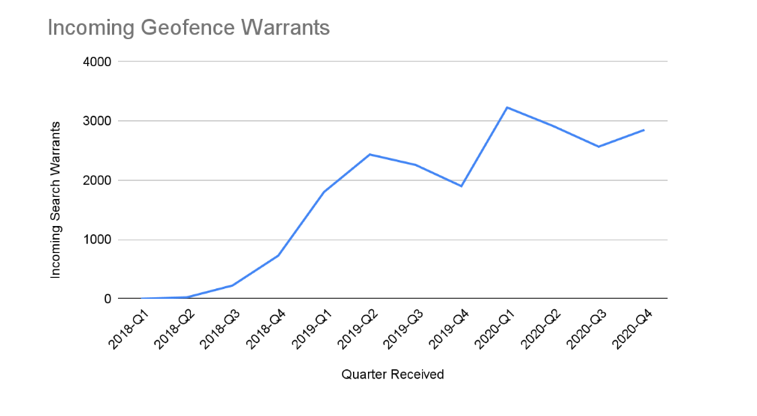
In late 2023, Google announced that it would begin storing users’ location history on their devices instead of in a centralized database. On the surface, this may seem to make geofence searches impossible. But it is unclear whether or not that is the case. Even after the change, Google continued receiving voluminous geofence warrants.
Fourth Amendment Implications
The Fourth Amendment to the Constitution protects people against unreasonable searches and seizures. The purpose of the amendment is to protect our freedom by making the police’s job more difficult— “to place obstacles in the way of a too permeating police surveillance.” Carpenter, 138 S. Ct. at 2214.
The Founders included the Fourth Amendment in response to the hated British “general warrants” that specified only a crime to be investigated and left to officers the discretion of whom and where to search. Carpenter, 138 S. Ct. at 2213. The “obstacles” the Fourth Amendment enshrined are the requirements that all search warrants must be based on probable cause and must be sufficiently particular. Judges evaluate whether these requirements in warrant requests before approving search warrants.
The probable cause requirement protects against arbitrary and groundless police searches. It requires the police to convince a judge that there is a “fair probability” that the search will unearth evidence of a specific crime. And if police want to search multiple people or places, they must have probable cause for each additional person or place, or else the warrant is unconstitutionally overbroad. In Ybarra v. Illinois, for example, the Supreme Court held that probable cause to search a bartender for evidence of drug dealing did not establish probable cause to search everybody in the bar. 444 U.S. 85 (1979). The Court explained that, constitutionally, a person isn’t suspect just because they happen to be near somebody committing a crime. Id.
The particularity requirement requires officers to particularly describe the place to be searched, the items sought, and the relation between those items and the underlying crime when applying for a search warrant. This is meant to ensure that police cannot engage in a wide, invasive fishing expedition not tied to the search’s justification. The particularity requirement requires warrants to limit an officer’s discretion in what to search and seize. For example, probable cause to believe someone has jaywalked should not permit the police to rifle through that person’s text messages and medicine cabinet.
A crucial preliminary question for Fourth Amendment analysis—especially in the geofence context—is exactly when a search occurs, because probable cause and particularity are evaluated each time a search is conducted. For geofence warrants, does a search occur at Step 1, when the government orders Google to query its entire database of location history to produce a list of who was in the area of interest at the right time? At Step 2, when Google provides the anonymous list of accounts within the geofence for the government to peruse and may provide additional location data outside the geofence? Only at Step 3, when Google unmasks who owns the accounts? All three?
Geofence searches and warrants raised many other important Fourth Amendment questions. One, for example, is whether the third-party doctrine should apply or, instead, whether Carpenter v. United States controls. In the pre-digital age, the Supreme Court ruled in cases such as Smith and Miller that government officers do not need to obtain search warrants to search information that people have voluntarily provided to third parties, such as call logs that telephone companies create in the course of enabling people to call each other, or bank statements that detail people’s financial transactions. This is called the third-party doctrine. In 2018, however, the Court recognized that the Digital Age changed the calculus. It ruled that the police did need a warrant to obtain historical records of a person’s cell-site location information (CSLI), which is a record of a person’s movement made by their cell phone pinging cell phone towers. The Court recognized that the government’s obtaining CSLI implicated far higher privacy interests than other information people provide to companies because location data is so sensitive, it can comprehensively expose a person’s whereabouts over time, it represents a form of retrospective surveillance that gives the government powers it previously did not have, and because people are not truly voluntarily providing CSLI but, instead, are automatically forced to in order for their phones to work correctly. The question in this case is whether a person’s Google Location History should receive the same protections as CSLI or a lower level of protection. Further, if police do need a warrant to conduct a geofence search, what does the warrant need to look like to satisfy probable cause and particularity?
Federal courts of appeals have addressed the question of geofence warrants’ constitutionality differently; the fact that they split from each other was likely influential for the Supreme Court’s decision to hear this case. In United States v. Jamarr Smith, the Fifth Circuit ruled that geofence warrants are inherently unconstitutional because, at Step 1, the government forces Google to search through many innocent people’s Location History in order to identify which accounts were within the geofence.


Support Our Work
EPIC's work is funded by the support of individuals like you, who allow us to continue to protect privacy, open government, and democratic values in the information age.
Donate