Analysis
To protect kids online, don’t ban them from social media. Regulate design.
April 30, 2026 |
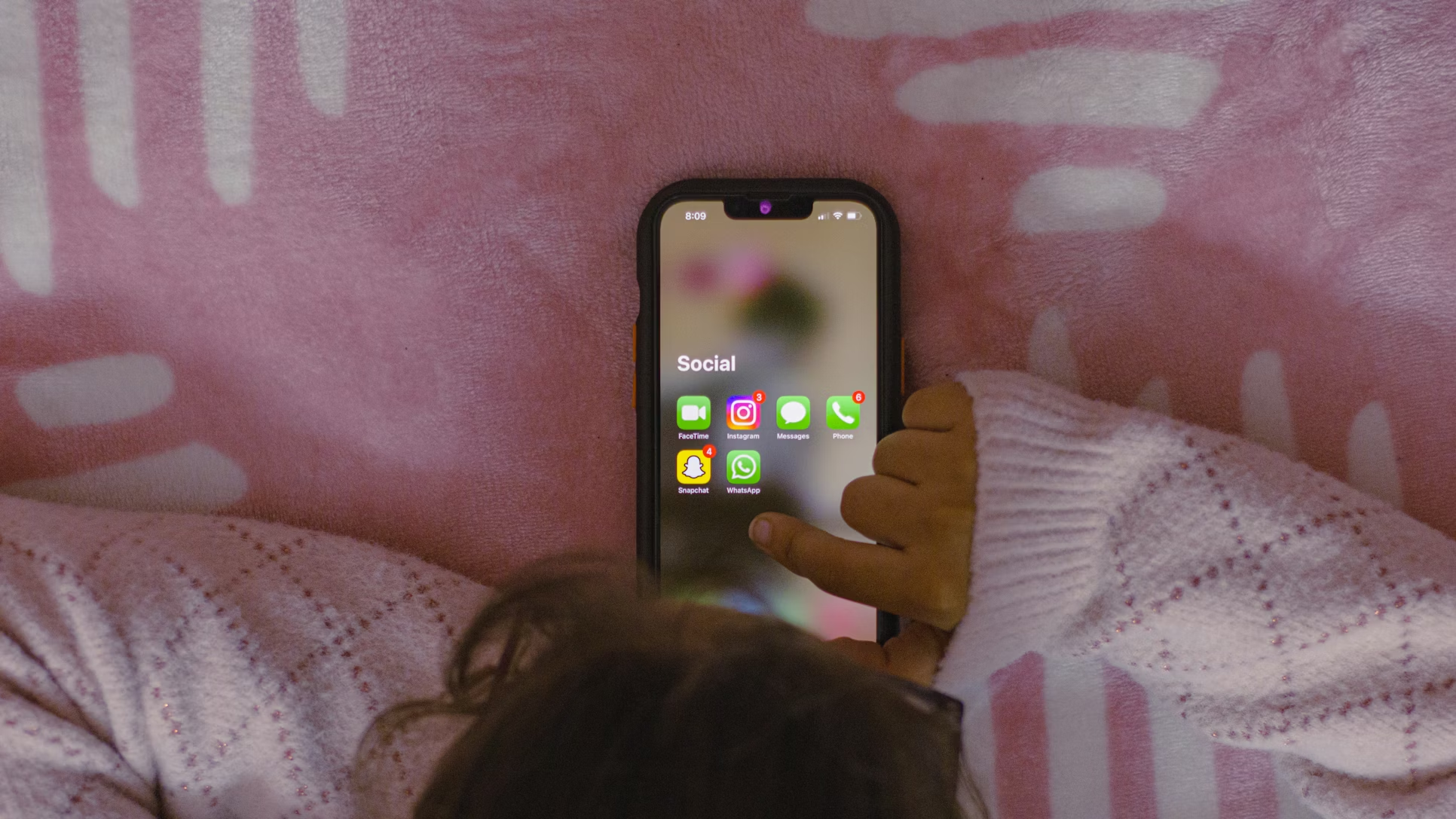
There is growing momentum in the states to do something to protect kids from harm online. Governors in multiple states have made kids’ online safety a priority for their administrations. Lawmakers across the country have introduced a wide range of bills aimed at protecting kids online. The public is eager for government intervention. And the recent jury trial verdicts in two cases against Meta and Google for manipulative design show that it is possible to hold tech companies accountable for designing their platforms in ways that cause harm to kids.
Unfortunately, many state bills do not focus on regulating tech companies’ harmful design practices but instead on blocking kids’ access to social media and other apps unless they get parental consent. This is not an effective way to protect kids online. For one, restricting kids’ access to social media is almost certainly unconstitutional and unenforceable. It also doesn’t get at the root of the problem.
Tech companies’ manipulative and otherwise abusive design practices are what drive many of the harms kids experience online. Prohibiting kids from accessing social media doesn’t solve the design problem. They will find their ways back onto the platforms somehow—either through parental consent or circumvention—and be exposed to the same harm. Regulating companies’ harmful design choices is the solution. That is why EPIC published a model age-appropriate design code earlier this year: to help lawmakers meaningfully and effectively protect kids online without compromising on privacy or speech.
The problem is design.
Kids today spend a lot of time online—often more time than they or their parents would like. This is by design. Mounting evidence shows that the leading tech companies fine-tune their products to extract as much time and data from users as possible because more time spent and more data collected translates into more advertising dollars. Popular components of online products, like infinite scroll, autoplay, push notifications, and algorithmic feeds that behaviorally profile users, are not designed to give people what they want but to keep users strapped to their devices while the companies mine them for their data and attention. These products are not meant for you to use but to use you.
Tech companies’ relentless pursuit of profit has human costs, particularly for children and teens, who are especially vulnerable to the psychological manipulation companies employ. Compulsive use is the primary human cost—where users regret how much time they spend staring at their screens but can’t seem to stop. There are also secondary effects, like depression, anxiety, eating disorders, suicidal ideation, and self-harm.
Many of the harms that are attributed to the content on social media actually stem from tech companies’ decisions to design their products to maximize extraction. Consider a paradigmatic example: a teen that is continuously shown content that reinforces their negative body image on a social media platform, resulting in anxiety, depression, and perhaps even self-harm. This content is not necessarily any more prevalent on social media than elsewhere. Nor is the social media company likely making an explicit choice to promote such content to teens. Social media companies design their algorithmic feeds to surveil user behavior, profile the user, and then predict and serve the content that will keep the user on the platform—with little regard for what the content communicates. For a teen with body image issues, content that feeds their insecurities about their body may keep them watching, clicking, and scrolling, so the algorithm repeatedly surfaces such content for them, resulting in a compulsion to keep scrolling, even when continued use results in spiraling self-criticism. For a different teen, a compulsion to keep scrolling can result from a stream of innocuous content such as absurdist memes, which can also cause anxiety, depression, and other consequential injury despite the lack of harm inherent to the underlying content. The fix in both cases is to prohibit behavioral profiling aimed at maximizing kids’ time online, not to restrict kids’ access to content.
Kids also sometimes have bad experiences online because companies are not designing their platforms with kids in mind. Some social media companies’ decisions to weaken or not offer certain design features, like blocking tools, increases risks of cyberbullying and harassment. The design of algorithmic recommendations for new friends on many social media platforms can also be problematic. These features can recommend that kids connect to adults they don’t know, and vice versa. On some platforms, like Facebook and Instagram, these features have been shown to recommend that kids connect to known adult groomers. As currently designed, these features increase the risk of kids experiencing sexual exploitation and physical harm.
It does not have to be this way. Social media, in its essential form, is a place where people from distant places can meet and discuss shared interests and concerns. For kids who lack friends or in-person support, social media can be a lifeline. Kids are unable to move to places where they are accepted. Providing kids with communication tools to reach people in different parts of the country or the world who do accept them is good for their mental health and well-being. Social media should be designed to allow kids to access these benefits without being subject to exploitation.
The law must force change.
Companies are aware that their design choices endanger kids. And they could make different choices. But they don’t. The profit incentive is too strong. And the companies do not think that anyone can hold them accountable for their harmful choices. Over the last few decades, Big Tech has campaigned to turn legal doctrines like Section 230 and the First Amendment into their own get-out-of-jail-free cards. And they believe they have succeeded, although cracks are beginning to show in the immunity shield, like in the verdicts against Meta and Google a few weeks ago. The result is that companies treat kids’ online safety as a public image issue that can be managed by creating the illusion of safety. They make symbolic gestures—a statement about the importance of kids’ well-being here, a safety feature that either doesn’t work or is not turned on by default there. But effective, voluntary safety measures remain elusive.
The law must act as a counterweight to the strong profit incentive companies have to design their products to capture kids’ data and attention. Enforcing existing laws is one pathway to reform. Ongoing litigation against tech companies—particularly the massive nationwide litigation against the biggest social media companies for addictive design—may well result in some important industry changes. But the litigation may take many more years to resolve due to the number of pending cases and subsequent appeals, and the result may only be a partial fix. For instance, baseline data protection, like companies minimizing the data they collect about users, is unlikely to result from these lawsuits. Existing law in the United States simply does not do enough to protect kids’ (or adults’) online privacy.
Legislatures can step in to force more immediate and comprehensive change. But any law must be carefully drafted. Industry actors—most notably, Big Tech trade association NetChoice—are systematically challenging tech accountability laws in court, invoking the First Amendment, Section 230, and other legal doctrines that they hope can be repurposed to fill the cracks in their immunity shield.
In addition to passing through industry’s legal gambit, kids’ online safety laws also must not compromise kids’ (or adults’) privacy or speech interests. In particular, any requirement to determine users’ ages must prioritize privacy, else the data could be used to recreate many of the problems regulation aims to solve. Kids and adults also have an interest in accessing protected speech, and legislation meant to protect kids should not trample on these rights.
Design regulation can accomplish these goals. But social media bans cannot.
Social media bans won’t fix the problem.
In many states, the kids’ online safety bills with the most momentum right now require every social media user to verify their age as a condition of access. These bills then restrict kids’ access in some way. Some of the bills prohibit kids under a certain age from accessing social media altogether. Others require users flagged as minors to get their parents to consent to their access. Still others restrict the time minors can spend on the social media (to, e.g., two hours a day) and allow parents to extend that timeframe.
Banning kids from social media, or requiring their parents to mediate their access, is almost certainly unconstitutional under current Supreme Court precedent—and for good reason. Design regulation would more effectively accomplish lawmakers’ stated goals without restricting anywhere near as much speech as access restrictions.
Social media bans burden kids’ First Amendment rights.
Minors have a First Amendment right to access social media, and government restrictions on their access burden that right. Beginning in Reno v. ACLU, the Supreme Court has repeatedly held that people have the same rights to access information online as they do offline. Social media platforms host vast quantities of information, almost all of which users undeniably have a right to access under the First Amendment. These platforms also facilitate communication and association among users, often on topics that form the core of First Amendment protections. Recognition of these facts led the Court to explicitly acknowledge a First Amendment right to access social media in Packingham v. North Carolina. There is no reason to think that this right does not extend to kids. As the Court explained in Brown v. Entertainment Merchants Association, kids’ speech rights are nearly co-extensive with those of adults. It is only in rare circumstances when there is a “longstanding tradition” of the government restricting kids’ access to speech that the First Amendment does not apply. While such a tradition exists for certain categories of content on social media, like materials obscene for minors, there is no tradition of restricting kids’ access to the overwhelming majority of material found on these platforms.
Conditioning kids’ access to social media on parental consent, or limiting their access to a few hours a day unless a parent grants them more time, does not cure the constitutional infirmity. The Supreme Court squarely confronted this issue in Brown, where it held that a statute requiring minors to obtain parental consent to purchase violent video games burdened kids’ speech rights and was unconstitutional under the First Amendment. A government-imposed requirement for kids to obtain parental consent to access social media similarly burdens kids’ speech rights, and the government must show that the law is properly tailored to a legitimate government interest.
Social media bans restrict much more speech than necessary.
Restrictions on kids’ access to social media will almost certainly fail constitutional scrutiny because they are not properly tailored to the government’s interest in protecting kids from harm online. In Packingham, the Court struck down a statute that prohibited registered sex offenders from accessing social media because it burdened far more speech than necessary to achieve its goal of protecting kids from sexual assault and abuse that might follow from online contact with sex offenders. Even for Justice Alito, who concurred in finding the law unconstitutional but wrote separately to explain that a more narrowly tailored law might pass constitutional scrutiny, the law was clearly unconstitutional because the design of many of the restricted websites did not lend themselves to the kind of information gathering or secret luring that might facilitate child abuse. Notably, the Court held that this law failed even under intermediate scrutiny, which is more deferential to the government than the infamous strict scrutiny.
A restriction on kids’ access to social media should also fail intermediate scrutiny because such a law burdens far more speech than necessary to achieve any legitimate interest the government has in protecting kids from harm online. First, some of the goals lawmakers provide for these laws are not legitimate government purposes, like protecting kids from some nebulous idea of “harmful content.” That is just censorship in the guise of child protection. As the Supreme Court said in Erznoznik v. Jacksonville, “speech that is neither obscene as to youths nor subject to some other legitimate proscription cannot be suppressed solely to protect the young from ideas or images that a legislative body thinks unsuitable for them.” And even if the government did have a legitimate interest in protecting kids from some harmful content, restricting their access to all content on social media to protect them from some of it is wildly overbroad.
Restricting kids’ access to social media is overbroad even as a means of achieving the government’s legitimate goals of protecting kids from harmful contacts and compulsive use. These goals can be achieved by regulating platform design instead of access. As Justice Alito pointed out in his Packingham concurrence, not all social media platforms lend themselves to harmful contacts. The design of some platforms may facilitate abuse, like providing friend recommendations that suggest kids connect with adults they don’t know or refusing to provide effective blocking tools. A far less restrictive means of protecting kids from harmful contacts is thus to regulate the design of the platforms.
When it comes to protecting kids from compulsive use, the answer again is that regulating design is a far less restrictive means of achieving the government’s goal. As explained above, compulsive use can be traced to explicit decisions tech companies make to design their platforms to extract the maximum amount of time and data from users. Prohibiting these designs and changing companies’ incentives to design in this way is an effective means of protecting kids from compulsive use that also allows kids to speak and maintain full access to the information on the platforms.
Social media bans are ineffective.
What’s more, access restrictions are generally an ineffective way to protect kids because they do not address the cause of the harm: the design of the platforms. The ineffectiveness of access restrictions has both practical and constitutional implications. Practically speaking, many kids will circumvent access restrictions and find themselves back on platforms with no protections. This is exactly what is happening in Australia, where the government’s eSafety Commissioner reported that 7 out of 10 minors under 16 still had social media accounts months after the country’s social media ban went into effect. Laws that allow kids to access social media if a parent consents are especially ineffective at protecting kids from harm. These laws allow kids to access restricted platforms—and be subjected to harm—as long as one parent relents.
To protect kids who are able to access regulated platforms, either through circumvention or parental consent, lawmakers would have to combine access restrictions with prohibitions on abusive design. But then the question would be, is the access restriction adding any additional protection beyond the design regulation? And is that additional protection justified, given the vast amount of speech that access restrictions burden? The answer is a resounding no, precisely because design regulation, on its own, effectively mitigates harm to minors while preserving their rights to speak and access information. Thus, from both a policy and a constitutional perspective, there is no need to impose restrictions on access.
This does not mean that there is nothing the government can do to help parents manage their kids’ access to or time on social media. The Court in Brown suggested that the government might be able to require companies to enforce a parent’s choice to prohibit their kid from obtaining violent video games. In the social media context, lawmakers might require tech companies to build parental control tools to prohibit or limit their kids’ access, as long as the government-mandated default is full access.
Regulating design should also lead kids to spend less time online. Tech companies’ manipulative design practices keep them online when they would prefer to leave. Eliminating the “addictive” design elements will help kids realize their own goals of spending less time online.
Recent Supreme Court decisions do not support social media bans.
Some may think that the Supreme Court’s decisions approving of age verification mandates for online obscenity and banning TikTok support the constitutionality of social media bans. But they don’t.
The Supreme Court’s decision in Free Speech Coalition v. Paxton last year doesn’t make social media access restrictions any less unconstitutional. In Paxton, the Court said that an age verification mandate is constitutionally sound if the government is using it to regulate conduct or speech that is within its power to regulate. So, the government can require age verification for the sale of alcohol and cigarettes, and for access to material obscene for minors, because the government has the power to regulate kids’ access to alcohol, cigarettes, and obscenity. But under current precedent, it is quite clear that the government does not have the power to ban kids from accessing social media or to require kids to have parental consent to access it. Indeed, there is little justification for imposing an age verification burden on every person—minor and adult—who wishes to access social media when the government can, instead, require the social media companies to make their products safer by design.
The Court’s decision to uphold the TikTok ban in TikTok v. Garland also does not support the constitutionality of a broader social media ban. The court upheld the TikTok ban based on the specific circumstances present in “a foreign adversary’s ability to leverage its control over the platform to collect vast amounts of personal data from 170 million U. S. users.” In national security situations like this, courts are typically much more deferential to the government’s preferred means of achieving its goal. These special circumstances simply do not apply to most social media companies.
Appellate decisions allowing social media laws to go into effect do not mean bans are constitutional.
Given the clear precedent indicating that social media bans are unconstitutional, it is no wonder that every trial court that has ruled on the merits of these bans has decided to enjoin them. And while appellate courts have allowed two laws styled as social media bans to go into effect while litigation over their constitutionality continues, these rulings do not mean that bans will ultimately be upheld by the Supreme Court.
In NetChoice v. Uthmeier, a three-judge panel of the Eleventh Circuit ruled 2-1 that a Florida social media law could go into effect pending appeal. But this law is not actually a social media ban. It is an unnecessarily convoluted design regulation masquerading as a social media ban. The law defines “social media platform” through a list of addictive design features, like infinite scroll and autoplay, and then requires companies that offer social media platforms to restrict minors’ access to the products. Companies can avoid the ban if they simply remove the addictive design features from their products. The law thus functions much like a prohibition on those design features. But because the law is structured and messaged like a social media ban, it is more vulnerable to public and constitutional attack than a straightforward design regulation. The law also invites tech companies to engage in malicious compliance by following the letter of the law—verifying every user’s age and banning kids—instead of getting rid of the prohibited design features. What’s more, the Eleventh Circuit has yet to consider the constitutionality of prohibiting the specific design features that define a social media platform. The state is unlikely to prevail in defending its inclusion of some of these features, like livestreaming and literally all personalized feeds. While social media “bans” that are really just design regulations may fare better in court than an actual ban, they are still far more legally vulnerable than a clear-cut design law.
In NetChoice v. Fitch, the Fifth Circuit and the Supreme Court have both allowed Mississippi’s actual social media ban to temporarily go into effect after a district court enjoined it. But that likely has more to do with NetChoice’s sloppy litigation tactics than the merits of the constitutional arguments in favor of social media bans. The last time NetChoice brought a case to the Supreme Court, the justices ripped it apart for seeking a complete injunction against two laws without showing that a substantial number of the laws’ applications were unconstitutional. In the aftermath, several federal appellate courts, including the Fifth Circuit in this very case, have chastised NetChoice for bringing similarly nebulous challenges against other tech regulations. And the one district court judge to deny NetChoice an injunction against a social media ban—in Tennessee—did so not on the merits but because NetChoice failed to demonstrate that anyone would suffer irreparable harm if the injunction was not granted. It is thus telling that Justice Kavanaugh—who was the only justice to explain their decision to allow Mississippi’s law to go into effect—attributed his decision to essentially the same problem as the district court judge in Tennessee: NetChoice’s failure to prove that it met all the requirements for a stay. When it came to the likelihood that NetChoice would succeed on the merits, though, Justice Kavanaugh was clear: the law likely violates the First Amendment under current precedent.
The Supreme Court is unlikely to limit or overturn current precedent.
It is unlikely that enough Supreme Court justices would vote to limit or overturn current precedent and uphold social media bans for kids. The justice most likely to bite is Justice Thomas, who wrote a dissent in Brown that argued that kids do not have a right to access information without their parents’ approval. But no other justice joined that opinion. And none of the justices who have since joined the Court— save, perhaps, Justice Gorsuch—are likely to join him now given the positions they have taken in Moody and Paxton. Justices Kagan and Sotomayor, meanwhile, were in the majorities in both Packingham and Brown and are unlikely to change their votes.
That leaves Justices Alito and Roberts, who concurred together in both Packingham and Brown. In both cases, the justices agreed with the majorities that the laws before them were unconstitutional because their definitions of the regulated products—video games and social media—were vague or overbroad. But Justice Alito’s concurring opinions—which the Chief Justice joined—suggested that the design of certain technologies could justify restrictions on access. Consequently, Justices Alito and Roberts might be persuaded that the addictive design of some social media platforms justifies imposing parental consent requirements on kids’ access. They may even be able to recruit Justices Thomas and Gorsuch to this view. Justices Barrett and Kavanaugh are also possibilities, but they would be harder sells.
This outcome is highly unlikely because, even under Alito’s reasoning in these cases, social media bans are unconstitutional. These laws generally suffer from many of the same infirmities as Alito and Roberts found with the laws in Packingham and Brown. Social media bans tend to define “social media” in a way that does not track with technologies that actually cause harm. Indeed, industry lawsuits have attacked sloppy drafting of coverage definitions in social media bans,and district court judges have been sympathetic to these arguments.
What’s more, the design elements Alito identified as contributing to harm in Brown and Packingham—the interactivity of video games, and the ability to covertly communicate on certain social media platforms—were inextricably intertwined with the technology, and so there were no alternative regulatory options in those cases that were significantly less restrictive than access restrictions. That is not the case with addictive design. The government can prohibit addictive design without destroying social media. In fact, such regulation would make social media better.
In sum, social media bans are both constitutionally suspect and functionally inadequate at getting to the core harms of social media for kids. Which is why lawmakers should skip the bans and regulate design.
Regulating design is the solution.
Since the design of these products is the problem, regulating design is the solution. Legislation narrowly targeted at abusive design will help protect kids from harm online without compromising kids’ (or adults’) privacy or speech interests. In fact, regulating design will improve privacy and autonomy, which will bolster free expression online. That’s why young people both in the United States and abroad support design legislation—and oppose bans.
A carefully drafted design regulation also stands a much better chance of withstanding an industry legal challenge than a law restricting kids’ access to social media. Indeed, recent litigation over early design regulation laws has helped inform the drafting of new models—including EPIC’s model age-appropriate design code—making it even more likely that these laws can ultimately be enforced.
Design laws are more effective and more likely to survive legal challenge than social media bans.
Design laws have several advantages over social media bans. For one, design laws target the content-agnostic aspects of online product design, like data processing, algorithmic design, and user interface design that are responsible for much of the harm kids face online. Design laws require baseline data protections, like data minimization and purpose limits; basic privacy and safety features, like blocking and filtering tools; and prohibitions on harmful design choices. These requirements will free kids from tech companies’ manipulative design, allowing them to make better choices about how much time to spend online and to have better experiences while they are there. It will also give new platforms that include privacy and safety by design a fighting chance to compete with established platforms.
A well-crafted design law also will not burden users’ access to social media and so will not raise the same First Amendment issues as social media bans. The best design laws will be drafted so that companies can comply by providing all users protections by default, no matter their age. To the extent that users are required to prove their age, that should only happen at the feature level, if and when a user wishes to opt out of protections. For example, a user who wants to turn on infinite scroll or autoplay may have to signal that they are an adult to turn those design features on, but they should not have to prove their age to access any online product or service. What’s more, unlike social media bans, the Supreme Court’s decision in Free Speech Coalition v. Paxton supports the constitutionality of age assurance requirements in design laws, since the government has the power to regulate product design for kids’ safety.
Finally, because design laws target content-agnostic aspects of design, they are less likely to run afoul of the First Amendment than social media bans. Tech companies’ primary argument against design laws is that they interfere with their protected editorial judgement. But the Supreme Court in Moody was only willing to recognize that a very narrow category of platform decision making—their enforcement of content moderation policies—resembled the expressive decisions traditional media make to select and publish speech. In fact, the Court signaled skepticism that behavioral profiling—the primary method companies use to generate content feeds—was expressive at all. Other manipulative design elements, like infinite scroll and autoplay, have more in common with casino game design, which has long been regulated consistent with the First Amendment.
For these reasons, some provisions of design laws likely do not implicate the First Amendment at all, and to the extent that any of them do, it is only incidentally or as a content-neutral time, place, or manner restriction subject to intermediate scrutiny—which they will likely pass. Indeed, privacy laws have a strong track record of surviving First Amendment challenges, as long as they do not unfairly target speakers based on their viewpoints. The jury verdicts in the New Mexico and California cases against Meta and Google also show that it is possible for design regulation to overcome First Amendment and Section 230 challenges, as these cases hold tech companies liable for the same kinds of design decisions targeted in design laws. These are not the only cases where plaintiffs have successfully overcome Big Tech’s supposed immunity shield. Over the last fifteen years, courts have increasingly found that Section 230 does not bar claims that tech companies’ design choices caused harm. Just a few weeks ago, Massachusetts’ highest court held that Section 230 does not bar any of the state’s claims that Meta designed their platform to be addictive for kids, adding yet another major victory for design accountability.
NetChoice’s struggle to win broad immunity rules in its challenges to two California design laws further demonstrates the viability of design regulation. Starting with Moody, NetChoice has repeatedly tried (and failed) to establish that regulating data privacy, online product design, and kids’ safety online are fundamentally inconsistent with the First Amendment. While the district court in the California’s Age-Appropriate Design Code (“CAADC”) case has twice given NetChoice what it wanted, the Ninth Circuit has twice reversed based on Moody, instead finding only limited issues with the way the CAADC was drafted. These issues can easily be avoided in future legislation by not requiring companies to opine on what content is “harmful” (in fact, they should not mention “harmful content” at all), enumerating and concretely defining the harms companies should assess their designs for, and imposing specific, concrete requirements on companies, not vague standards.
In the case against California’s Protecting Our Kids From Addictive Social Media Act, NetChoice has fared even worse. The trade group was unable to convince the district court to enjoin the central provision—a limit on the use of personal data to generate “addictive” algorithmic feeds—because the judge, relying heavily on Moody and an EPIC amicus brief, did not think that behaviorally profiling users was likely an exercise in protected editorial discretion. The judge also refused to enjoin the law’s privacy mode default requirement, a requirement to turn like counts off unless a parent consents, and the age assurance provision. The Ninth Circuit upheld this decision except for the like count provision, although the opinion leaves open the possibility that providing minors with control over like counts is properly tailored to achieving the government’s goal. And while the district court enjoined provisions limiting push notifications, the judge was sympathetic to the regulation, suggesting the state might yet prove that it passes constitutional muster, and in any case, that the restriction would fare better if it applied to all companies that employ push notifications instead of only a few.
Crucially, the latest Ninth Circuit decisions in both cases confirm that design laws that apply to companies whose products are likely to be accessed by kids, or that apply to any company that employs a specific design feature (like an addictive feed) are not going to face the same constitutional problems as laws that only regulate social media. Courts have largely agreed with industry that lawmakers’ attempts to define “social media” are content-based and make the whole law subject to strict scrutiny. Part of the problem with these definitions stems from poor drafting and granting industry lobbyists with exceptions that make little sense. But a large part of the problem is that it is difficult to define “social media” in a clean way. There is also a fundamental issue with only regulating social media when other types of online products use abusive design and thus warrant regulation. The best approach is to regulate abusive design broadly, wherever kids are likely to be found.
EPIC’s model design code integrates lessons from recent court cases to protect kids online and survive legal challenge.
EPIC’s model design code bill integrates lessons from these and other platform accountability cases to provide lawmakers with language that will both effectively protect kids from harmful design and survive an industry legal challenge. The model is based on Vermont’s Age-Appropriate Design Code, which EPIC also helped draft. The model bill:
- Applies to all businesses whose products are likely to be accessed by kids and who use the regulated data practices and design features, addressing harm on social media and beyond.
- Prohibits specific, content-agnostic data processing and design features that have been shown to carry a significant risk of harm, like surveillance-based algorithmic feeds and invasive data collection. These protections must be provided by default for all users, ensuring that minors get protections without burdening users’ access to any online products.
- Requires companies provide users they know, or should have known, are minors with privacy and safety tools, like visibility, location, notification, and content controls that mitigate harm from unwanted contacts and compulsive use.
- Anticipates changes in technology by requiring attorneys general to issue periodic rules to update the law and requiring big companies to assess their design features on an ongoing basis for a specific harm: the risk of causing compulsive use in minors.
- Gives researchers, policymakers, and users transparency into companies’ design practices in a way that avoids First Amendment issues.
- Does not require age assurance but does requires companies that do use age assurance abide by strict privacy rules.
Lawmakers can help protect kids online. The way to do that is to regulate the design of online products—not to block kids’ access to social media. EPIC’s model provides a viable path forward.

Support Our Work
EPIC's work is funded by the support of individuals like you, who allow us to continue to protect privacy, open government, and democratic values in the information age.
Donate